Home     Contact     Projects     Experiments     Circuits     Theory     BLOG     PIC Tutorials     Time for Science     RSS     Terms of services     Privacy policy  
   
 Home      Projects     Experiments     Circuits     Theory     BLOG     PIC Tutorials     Time for Science   

13 March 2010
Author: Giorgos Lazaridis
How Relays Work


Relay Symbols and Characteristics

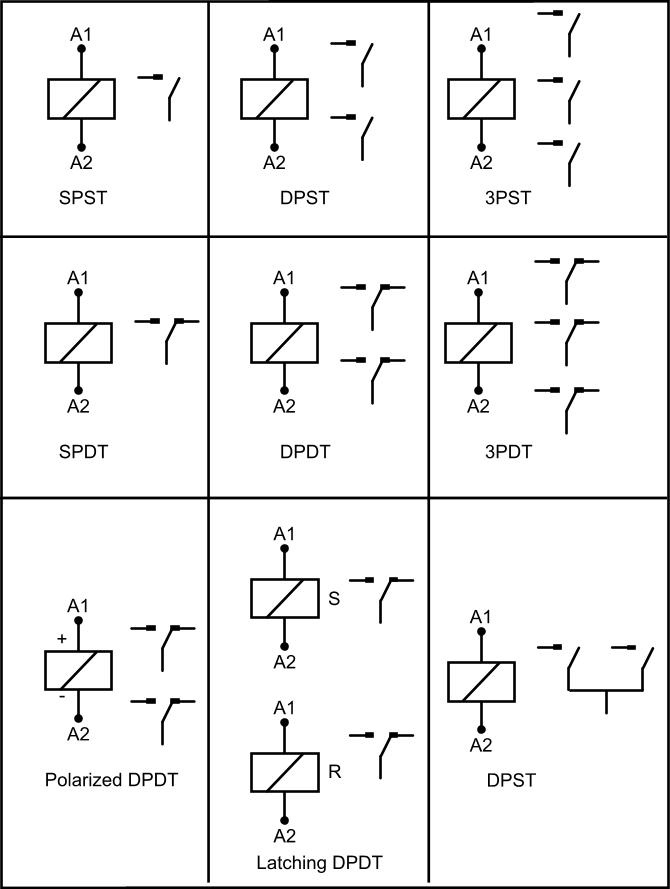
The relay symbols are unlimited. Each manufacturer can make his own symbol for a specific relay that has different internal connections and characteristics, carrying out a specific task. I will illustrate the most basic types of relays:


Relay Characteristics

A sample of a label from a relay

The things that characterizes a relay are the followings:

  • The coil voltage: This is the voltage that the coil can actuate the armature. This value should indicate also if the current is AC or DC

  • The coil current: This value indicates the current that the coil will draw when it is powered with the indicated coil voltage. Very important characteristic to take into account when designing the driver of the relay. The current that goes through the driver must be enough to actuate the armature.

  • The off-voltage: This characteristic shows the minimum voltage that the armature is pulled by the electromagnet. If the voltage goes bellow this value, the spring will overcome the magnetic force and the relay will change state.

  • The number/type of contacts: Is it an SPST? An DPST? DPDT? Or what?

  • The power for the contacts: This characteristic indicates the maximum power that the contacts can handle. Some manufacturers will use the voltage and the amperes, some others the voltage and the kilo-watts, while some others will indicate all three values.

  • The operating temperature: The temperature that the relay can operate without problems

  • Switching frequency: The maximum make-break frequency

  • The package: Last but not least is the package. Some packages (like the octal type) comes with an appropriate base, while some others are directly soldered/connected to the PCB/electric cabinet.


Comments

  • At 21 May 2013, 8:22:39 user salik wrote:   [reply @ salik]
    • thanks brother it was very helpful for me. Nice animations.


  • At 14 May 2013, 2:52:19 user Best wrote:   [reply @ Best]
    • This is very helpful! Thanks a lot for your efforts!


  • At 10 May 2013, 4:46:44 user amol wrote:   [reply @ amol]
    • very simple to understand and impressive.


  • At 19 April 2013, 19:26:14 user sudeep wrote:   [reply @ sudeep]
    • very nice explanation....good method to understand...use of animation is very helpful in understanding the concept...thanx alott:-):-)


  • At 15 April 2013, 14:10:17 user Snehal wrote:   [reply @ Snehal]
    • Great explanation ! I finally have understood how a relay works ! I hope u keep the website updated with more explanations !


  • At 11 April 2013, 3:59:49 user Harry wrote:   [reply @ Harry]
    • thank you for giving this information,it is easy to learn and nice explanation....


  • At 10 April 2013, 10:49:12 user Abhijeet wrote:   [reply @ Abhijeet]
    • good one! very helpful, thanks...


  • At 8 April 2013, 3:04:57 user kanyakumari wrote:   [reply @ kanyakumari]
    • very good explanation with showing pictures thanks a lot


  • At 5 April 2013, 2:22:27 user Neelam wrote:   [reply @ Neelam]
    • thanks for giving clear idea about relay.


  • At 29 March 2013, 13:19:17 user Giorgos Lazaridis wrote:   [reply @ Giorgos Lazaridis]
    • @ashmit maybe you want to control high load with small pushbutton or low voltage


  • At 29 March 2013, 4:31:57 user ashmit wrote:   [reply @ ashmit]
    • why do we have to use the electromagnet to put the switch on and y cant we just make the contact with a simple switch.


  • At 20 March 2013, 8:32:40 user manoj raut wrote:   [reply @ manoj raut]
    • That is very good method of understanding of relay opertion .
      But ,can you explain how can we are use relay for fan control


  • At 19 March 2013, 1:47:06 user saheer wrote:   [reply @ saheer]
    • Very helpful explanation thank u so much.......


  • At 18 March 2013, 6:01:41 user Mnagesh wrote:   [reply @ Mnagesh]
    • Can you please explain me what is meant by the "Potential free relays".
      As i want to integrate my device with the SCADA system they asked me to provide signal to SCADA device for 5 sec( means i want to complete there circuit using a potential relay) with the help of potential relays only.
      Or can i use any kind of relay to complete there circuit.


  • At 18 March 2013, 2:42:24 user Anusha wrote:   [reply @ Anusha]
    • Thanks a lot :)


  • At 11 March 2013, 10:47:43 user kiran kumar wrote:   [reply @ kiran kumar]
    • An easy way to analyse


  • At 10 March 2013, 11:20:53 user kiran wrote:   [reply @ kiran]
    • really great!!!! this is so helpful....


  • At 7 March 2013, 11:56:21 user kimani morgan wrote:   [reply @ kimani morgan]
    • sent me more ok.!!!!!!!!!!!!!!


  • At 6 March 2013, 18:19:38 user thilanka wrote:   [reply @ thilanka]
    • nice and simple explanation understood very well thank you sir.


  • At 28 February 2013, 7:51:08 user Mystique wrote:   [reply @ Mystique]
    • thank u so much for the awesome explaination it really helped me alot


  • At 22 February 2013, 21:18:56 user sram wrote:   [reply @ sram]
    • super


  • At 22 February 2013, 3:25:15 user Jayapriya wrote:   [reply @ Jayapriya]
    • Nice explanation


  • At 20 February 2013, 6:37:17 user vijay patel wrote:   [reply @ vijay patel]
    • thanks for giving the article.
      sir pls give me how many types of relay available in market with images pls reply me as fast as possible.


  • At 22 January 2013, 3:18:00 user Amit Arora wrote:   [reply @ Amit Arora]
    • i dont think there is a better way to make some one understand the relay operation...thankyou very much it was very helpful


  • At 16 January 2013, 4:03:12 user sourajit wrote:   [reply @ sourajit]
    • We can easily understand how Relay Work to study the chapter.


  • At 28 December 2012, 22:50:04 user swamy wrote:   [reply @ swamy]
    • great explanation.which had given a good idea about it.i hope more component explanation from u...thanq


  • At 28 December 2012, 10:17:07 user suresh kotgire wrote:   [reply @ suresh kotgire]
    • good one,really explained in a simple language with a detailled diagram.


  • At 26 December 2012, 1:45:18 user Mangesh wrote:   [reply @ Mangesh]
    • gr8 explanation with the concept.....nicely understood....thanx


  • At 23 December 2012, 7:26:49 user Aaron Chen wrote:   [reply @ Aaron Chen]
    • your explanation really help me understand what is relay about, I want to unerstand it from long time ago, but I just can't find other source that can help me understand easily like this!


  • At 20 December 2012, 8:02:02 user virendra wrote:   [reply @ virendra]
    • very nice explanation of relay operation

      Thanks Dear


  • At 5 December 2012, 23:53:21 user Harish wrote:   [reply @ Harish]
    • excellent explanation. finally understood the principle behind relays, and now it appears so simple!! keep up the good work.


  • At 2 December 2012, 23:10:28 user Etaa wrote:   [reply @ Etaa]
    • i thank you my fine sir. that was truly a good explanation. that clear everything up. your explanation and diagrams, true genius


  • At 20 November 2012, 22:34:16 user karthik wrote:   [reply @ karthik]
    • super explanation


  • At 19 November 2012, 18:25:41 user Prabhakar Kumar wrote:   [reply @ Prabhakar Kumar]
    • You are amazing .Very clear explanation with illustrative example.
      Thank you and keep on it............


  • At 17 November 2012, 10:06:41 user saiden ayob wrote:   [reply @ saiden ayob]
    • very nice demo... Excellent....


  • At 2 November 2012, 1:52:31 user Sinith wrote:   [reply @ Sinith]
    • Marvelous work ||||


  • At 11 October 2012, 4:25:26 user Binomon Abraham wrote:   [reply @ Binomon Abraham]
    • Nice & simple explanation. Very good

      Bino


  • At 29 September 2012, 2:53:31 user Mohamad Hilman Bin Ismail wrote:   [reply @ Mohamad Hilman Bin Ismail]
    • thanx 4 your explanation,proud to be an engineer..
      no doubt to take this course


  • At 28 September 2012, 3:34:48 user aniket wrote:   [reply @ aniket]
    • super like...!!


  • At 27 September 2012, 18:25:37 user krishna wrote:   [reply @ krishna]
    • its simply so beautiful i never expected such a beautiful answer from internet


  • At 25 September 2012, 9:00:50 user siri wrote:   [reply @ siri]
    • thank u so much... very useful to understand basic concepts of my small project


  • At 25 September 2012, 4:02:50 user Bhagwati wrote:   [reply @ Bhagwati]
    • good for knowlede


  • At 16 September 2012, 7:37:35 user Ansari yasar wrote:   [reply @ Ansari yasar]
    • Its too benifitial


  • At 9 September 2012, 10:56:34 user ajit wrote:   [reply @ ajit]
    • its too good


  • At 22 August 2012, 15:08:49 user Abe kaate wrote:   [reply @ Abe kaate]
    • good lesson with simple illustrations


  • At 14 August 2012, 14:13:58 user hari rana wrote:   [reply @ hari rana]
    • really informative..very easy to understand.. thanks


  • At 1 August 2012, 6:38:39 user sarang wrote:   [reply @ sarang]
    • grt explanation...


  • At 29 July 2012, 5:21:42 user dayalraj wrote:   [reply @ dayalraj]
    • sir,
      i also want to know about "limit switch" and its operation


  • At 27 July 2012, 21:50:58 user jesu wrote:   [reply @ jesu]
    • super sir thank you a lot... need more from your side


  • At 26 July 2012, 0:17:32 user T.dayalraj wrote:   [reply @ T.dayalraj]
    • i am a lecturer in a polytechnic. Now i can explain this relay topic in such a easy way to the students. i trust that every student can understand this topic about relay.
      dayalraj


  • At 18 July 2012, 1:16:22 user shubham wrote:   [reply @ shubham]
    • Grate..........best tutorial of relays


  • At 3 July 2012, 1:13:46 user Giorgos Lazaridis wrote:   [reply @ Giorgos Lazaridis]
    • @Mohammad Nofal Yes you can do that,that is what they are designed for. The coil is completely isolated from the contacts


  • At 3 July 2012, 0:43:48 user Mohammad Nofal wrote:   [reply @ Mohammad Nofal]
    • can we use two loads in the same relay output, one in NO & 2nd one in NC, does the relay coil or sping affected after several times of activation.


  • At 25 June 2012, 5:25:55 user prasanna m r wrote:   [reply @ prasanna m r]
    • superb! solved all my confusions


  • At 7 June 2012, 2:08:16 user muhammad imran mehdi wrote:   [reply @ muhammad imran mehdi]
    • well done very nice description


  • At 28 May 2012, 7:21:06 user cabdikilaas wrote:   [reply @ cabdikilaas]
    • thank u very much so that these way is helpeful procces that can understand every one life over the world or use these technical


  • At 24 May 2012, 22:42:25 user Dhruv solanki wrote:   [reply @ Dhruv solanki]
    • yeeeee it's very good


  • At 21 May 2012, 23:08:12 user mangesh wrote:   [reply @ mangesh]
    • best tutorial of relays


  • At 26 April 2012, 7:22:58 user edresym wrote:   [reply @ edresym]
    • very nice discription


  • At 25 April 2012, 2:14:27 user rizwan iftikhar wrote:   [reply @ rizwan iftikhar]
    • so nice description sir ...... and please describe other electronic component like this one in detail and graphically.......


  • At 17 April 2012, 3:04:53 user vinay wrote:   [reply @ vinay]
    • u explained it very easily


  • At 15 April 2012, 9:53:55 user Sandeep wrote:   [reply @ Sandeep]
    • Very good post...... Thank u very much......


  • At 8 April 2012, 0:51:55 user Muhammad Nasir wrote:   [reply @ Muhammad Nasir]
    • very easy to understand and excellent step wise approach, thnx


  • At 31 March 2012, 23:43:01 user hari wrote:   [reply @ hari]
    • thanx it was good.......and its language.is easy.......


  • At 30 March 2012, 23:06:42 user A. Rafay Inayet wrote:   [reply @ A. Rafay Inayet]
    • The way of Explaining is excellent. It will be more helpful for beginners as well.


  • At 27 February 2012, 3:21:53 user Giorgos Lazaridis wrote:   [reply @ Giorgos Lazaridis]
    • @shahzad you will need to use a transformer to convert 220 to 12. google for "ac/ac transformer"


  • At 27 February 2012, 2:48:54 user shahzad wrote:   [reply @ shahzad]
    • how can i operate relay with 220v
      and how can i convert 220v into 12v bc for relay operate


  • At 8 February 2012, 4:04:43 user Lineo wrote:   [reply @ Lineo]
    • I would like to have theory of 110V DC monitoring relays.How does it work when it monitors that Voltage does not drop and if it does send an alarm?


  • At 23 January 2012, 1:48:14 user adithyan wrote:   [reply @ adithyan]
    • thank u friend..,it helped me alot....


  • At 15 January 2012, 1:31:58 user jyothirmai wrote:   [reply @ jyothirmai]
    • thank you for giving this information,it is easy to learn and nice explanation..........


  • At 7 December 2011, 7:12:48 user krishna wrote:   [reply @ krishna]
    • nice explanation Thank u very much


  • At 12 November 2011, 4:36:02 user Kammenos wrote:   [reply @ Kammenos]
    • @John Miller the latching relay


  • At 11 November 2011, 21:51:46 user zahid wrote:   [reply @ zahid]
    • really nice animation for understanding the basic concept of relay.


  • At 11 November 2011, 9:00:58 user John Miller wrote:   [reply @ John Miller]
    • What type relay DPDT will remain in either position without the coil energized.


  • At 8 November 2011, 8:45:31 user Rakesh Bhati wrote:   [reply @ Rakesh Bhati]
    • Animated working is really very helpful to understand the basic concept of any mechanism....thanks for making this website...,,,


  • At 26 October 2011, 4:51:48 user sujit wrote:   [reply @ sujit]
    • Really, Really......Thank u


  • At 26 October 2011, 2:14:15 user shreyas wrote:   [reply @ shreyas]
    • really good work...helped me a lot.


  • At 22 October 2011, 22:58:26 user Aniruddh wrote:   [reply @ Aniruddh]
    • Its a good presentation. I have understood a lots of things from this website...Keep it up....


  • At 12 October 2011, 3:09:48 user Ziyanal wrote:   [reply @ Ziyanal]
    • ya buddy, very nice....wish you would have been my teacher during my college days...thanks a lot


  • At 11 October 2011, 7:46:42 user hsb wrote:   [reply @ hsb]
    • excellent explanation !!! keep more coming
      thanx !!


  • At 20 September 2011, 5:02:52 user pavithra.s wrote:   [reply @ pavithra.s]
    • really i like this of explanation.if we are reading in book.we can,t understand fully.sometimes it will be confusing.if we read the operations of instruments on animation,it will be usefull.so you have a good sense.please continue this.


  • At 7 September 2011, 1:39:39 user sushil wrote:   [reply @ sushil]
    • Really nice explanation.One of the simplest explanations for understanding relays


  • At 3 September 2011, 3:15:12 user Prashant wrote:   [reply @ Prashant]
    • Very easy explanation,Thanks


  • At 26 August 2011, 6:55:02 user ram wrote:   [reply @ ram]
    • thank you for giving this information,it is easy to learn


  • At 25 July 2011, 20:30:35 user krish wrote:   [reply @ krish]
    • Thanks a lot. What an clear/ excellent explanation...


  • At 3 July 2011, 1:36:38 user ilavarasan wrote:   [reply @ ilavarasan]
    • this is the excellent explanation, thanks


  • At 22 February 2011, 4:21:15 user Rasmi Ranjan Nayak wrote:   [reply @ Rasmi Ranjan Nayak]
    • Hello,
      This is one of the best informative pictorial representation I have ever seen. The flow is very coherent.

      Thanks Buddy.... Keep it Upppppp


  • At 12 November 2010, 3:33:46 user Gangat Mohsin... wrote:   [reply @ Gangat Mohsin...]
    • Thank you for the serail flow for the process in detail......


  • At 28 June 2010, 12:01:31 user ravi wrote:   [reply @ ravi]
    • i like the way you discuss i really thankful that i got such a gud explanation. but i would like to request to discuss more on induction motor for industrial application.


     

      Name

      Email (shall not be published)

      Website

    Notify me of new posts via email


    Write your comments below:


    delicious
    digg
    reddit this Reddit this
    Faves


     HOT in heaven!

    Find us on Facebook


    NEW in heaven!


    New Circuit: Bistable relay


     Contact     Forum     Projects     Experiments     Circuits     Theory     BLOG     PIC Tutorials     Time for Science     RSS   

    Site design: Giorgos Lazaridis
    © Copyright 2008
    Please read the Terms of services and the Privacy policy