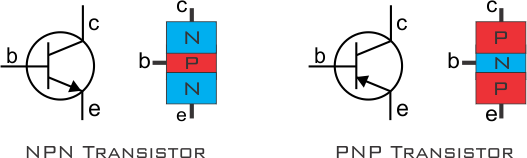
A BJT (Bipolar Junction Transistor) transistor has inside two similar semiconductive materials, and between them there is a third semiconductive material of different type. So, if the two similar materials are P and the middle one is N, then we have a P-N-P or PNP transistor. Similarly, if the two materials are N and the middle one is P, then we have a N-P-N material or NPN.
Each transistor has 3 leads which we call base, collector and emitter, and we use the symbols b, c and e respectively. Each lead is connected to one of the 3 materials inside, with the base being connected to the middle one. The symbol of the transistor has an arrow on the emitter. If the transistor is a PNP, then the arrow points to the base of the transistor, otherwise it points to the output. You can always remember that the arrow points at the N material. These are the symbols:
Transistor operation
We will now explain the operation for the transistor, using an NPN type. The same operation applies for the PNP transistors as well, but with currents and voltage sources reversed.
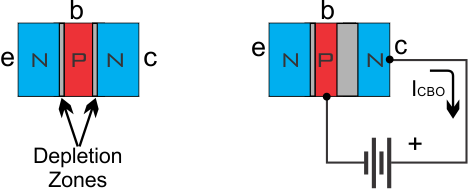
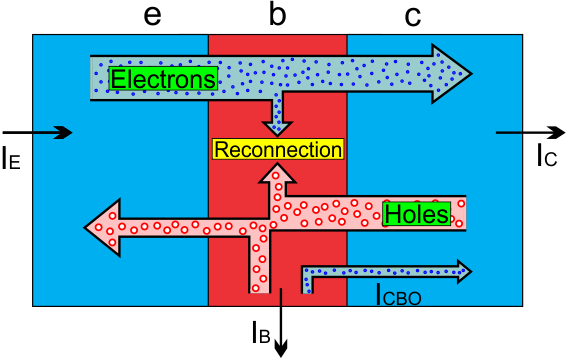
With no power applied to the transistor areas, there are two depletion zones between the two P-N contacts. Suppose now that we connect a power source between the base and the collector in reverse-bias, with the positive of the source connected to the collector and the negative to the base. The depletion zone of the P-N contact between the base and the collector will be widened. Moreover, a slight current will flow withing this contact (due to impurities). This current is the reverse contact current and we will use the symbol ICBO:
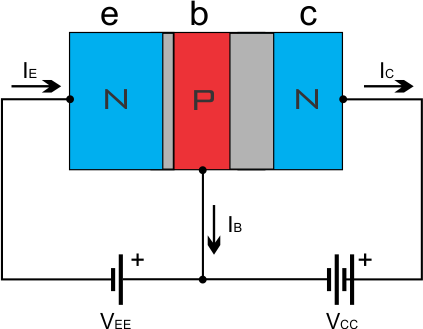
Now suppose that we connect another voltage supply between the emitter and the base in forward bias, with the positive of the source connected to the base and the negative connected to the emitter. The depletion zone between the emitter and the base will be shortened, and current (electrons) will flow when the voltage exceeds a specific level. This level depends on the material that the transistor is made of. Germanium (Ge) is the material that was originally used to make transistor, and later Silicon (Si) was used. For Germanium, the voltage is around 0.3 volts (0.27 @ 25oC), and for Silicon the voltage is around 0.7 volts (0.71 @ 25oC). Some of the electrons that go through the e-b depletion zone, will re-connect with holes in the base. This is the base current and we will use the IB symbol for reference. In real life, this current is at the scale of micro-amperes (μA or uA):
But most of the electrons will flow through the base (due to spilling) and will be directed to the collector. When these electrons reach the depletion area between the base and the collector, they will experience a force from the electric field which exists in this zone, and the electrons will pass through the depletion zone. The electrons will then re-connect with holes in the collector. The re-connected holes will be replaced with holes coming from the base-collector power supply (VCC). The movement of these holes equals to a movement of electrons in the opposite direction, from the collector to the supply. In other words, the current that flows to the emitter will be divided into the small base current and the larger collector current:
IE = IB + IC
Generally, the number of electrons that arrive at the collector is the 99% of the total electrons, and the rest 1% causes the base current.
At the collector, except the electrons that come from the emitter, there is also the reverse current from the base-collector contact that we saw before. Both currents flow at the same direction, so they are added:
IC' = IC + ICBO
The following drawing shows how the electrons and holes flow within the transistor:
This is generally what happens inside a transistor when voltage is applied. The purpose of this theory is to explain how can someone use the transistor to design an amplifier or a switch, so we will not go into many details. It is enough to know this basic operation.
The hybrid parameters [h]
The hybrid parameters are values that characterize the operation of a transistor, such as the amplification factor, the resistance and others. They are used to calculate and properly use the transistor in a circuit. Most of the the hybrid parameter values are given in the datasheet by the manufacturer. You do not need to learn everything about hybrid parameters to design a transistor circuit, but it is good to know that they exist. Here is a quick reference:
The hybrid parameters for Common Emitter (CE) connection
Here is the first set of hybrid parameters for a transistor connected with Common Emitter. For now you do not have to worry about the type of connection. We will discuss them thoroughly in the next chapters.
hie - input impedance
The first hybrid parameter that we will see is the hie. This parameter is defined by the result of the division of the VBE by IB:
hie = VBE / IB
This parameters defines the input resistance of a transistor, when the output is short-circuited (VCE=0).
hfe - Current Gain
This is the most important parameter and is extensively used when calculating a transistor amplifier. This is actually the only parameter you need to know to begin designing amplifiers. The equation for this parameter is the following:
hfe = IC / IB
When we have the output of the transistor short-circuited (VCE=0), hfe defines the current gain of the transistor in common emitter (CE) connection. Using this parameter we can calculate the output current (IC) from the input current (IB):
IC = IB x hfe
This explains why this parameter is so useful. A BJT transistor has typical current amplification from 30 to 800, while a Darlington pair transistor can have an amplification factor of 10.000 or more. Another symbol for the hfe is the Greek letter β (spelled "Beta").
hre - Dynamic transfer ratio reverse voltage
This parameter is calculated with this equation:
hre = VBE / VCE
If the input of the transistor is open (IB=0) then this parameter gives the voltage gain when the transistor is connected with common emitter (CE).
hoe - Output Conductivity
This parameter is defined with the input open (IB=0) and the transistor connected in common emitter (CE) connection. The equation is:
hoe = IC / VCE
With the above conditions, this parameter defines the conductivity of the output. So, the impedance of the output can be defined as follows:
ro = 1 / hoe = VCE / IC
The hybrid parameters for Common Base(CB) connectionhfb - Current Gain
Like in Common Emitter connection, in Common Base connection there is a current gain ratio which is defined by the manufacturer with the hfb parameter. In this type of connection, the current amplification is almost 1 which means that no practical amplification occurs. hfb is also symbolized with the Greek letter α (Alpha).
0.9 < α < 1
The formula to calculate this parameter is the following:
-hfb = IC / IE
The hybrid parameters for Common Collector(CC) connectionhfc - Current Gain
As you understand, the current gain is the most important parameter in every type of connection. Same applies for the common collector connection. The equation is as follows:
-hfc = IE / IB
An alternative symbol for hfc is the Greek letter γ (Gama).
Static and Dynamic operation
As we saw above, the hybrid parameters begin with the letter h, and then a pointer follows to define which parameter we are talking about. If the pointer is written with lowercase letters, then this parameter refers to dynamic transistor operation. We call dynamic operation when the transistor operates with AC voltage, like for example in an audio amplifiers. If the pointer of the h parameter is written with capital letters, then the parameter refers to static transistor operation. The transistor operates statically if there is only DC voltage, like for example in a transistor relay driver.
The current gain parameters have almost the same values in both static and dynamic operation. So, we can safely say that hFE is almost equal to hfe. Generally:
One of the most common problems that a circuit designer faces when using transistors, is the fact that the h parameters are very sensitive to temperature changes. The most annoying thing about this is that the current gain changes dramatically. In common emitter connection for example, hfe can increase by 60% if the temperature climbs form 25 to 100 degrees. Take also into account that a transistor dissipates power in the form of heat, so temperature increment is something common that happens all the time.
Another problem with hybrid parameters is that even between completely identical transistors, they may vary dramatically. You may have two transistors with the same code from the same manufacturer (completely identical) and yet one transistor may have hfe 150 and the other 300 (real measurement)! Within the next pages, we will see how can a designer work around with these problems.
to get more information about <a href="http://911electronic.com/tunnel-diode-characteristic-symbol-definition/">tunnel diode</a> click hotlink. I found this site yesterday and i think there is a lot information about diodes.
Hi,
Would you please tell that why the mentioned curvature happens? I have this problem in my TFT (Thin Flim transistor) and in the low voltage of D-S, D-S current does not like a diode curve and it has a curvature like you mentioned.
At 9 January 2014, 14:04:31 user Nash wrote: [reply @ Nash]
@Giorgos Lazaridis Your Diagrams for the current flow for a NPN connection are wrong. BIG MISTAKE Fix it please http://pcbheaven.com/wikipages/images/trans_theory_1317761009.png & http://pcbheaven.com/wikipages/images/trans_theory_1317761285.png
@Mint Electronics Sorry for 2 reasons: first for the loooong delay (i thought that i had posted the answer immediately), and sorry for not explaining this in the article. I will re-read the whole theory when i finish it and fix some issues like that. I though that it was not so important to explain it, but maybe i will put some spoilers with the proof. Anyway:
Question 1:
Vcc = Vb Vbe Ve => Vcc - Vbe = Ve Vb
But we can approximate that Ve = Ic x Re (since Ic almost = Ie)
Also, Vb = Ib x Rb => Vb = (Ic x Rb) / hfe
From the above:
Vcc - Vbe = (Ic x Re) [(Ic x Rb) / hfe] => (We get Ic in common)
Vcc - Vbe = Ic x [Re (Rb / hfe)] => (divide both sides with term)
(Vcc - Vbe) / [Re (Rb / hfe)] = Ic
Question 2:
The voltage divider current will always be bigger than the base current, since it is composed by the voltage divider current PLUS the base current.
@Mint Electronics Although i try to keep the math as simple as possible, the way you want me to re-arrange it would be more like a math tutorial rather than a transistor tutorial. I keep it simple but not that simple, it would be tiring and confusing for those who want to learn transistors.
As for the "arrow", it is not an arrow, it is the Greek letter %u03B2 (Beta) which probably you cannot see due to your browser's encoding used. It is good to know that there are people who cannot follow this encoding. This %u03B2 letter is the same as the hfe. In formulas we use %u03B2 rather than hfe for short. I think i have to find something else to show this....
In the meanwhile try to change your encoding and the correct letter will reveal.
Hey!
This is a good tutorial, however I am a bit lost in the math by the way you write it.
Would it be possible to rearrange it and have the formula go down the page e.g.:
5*(2 2)
=5*(4)
=5*4
=20
Also can you please explain to me the arrow that you use in the formulas, what does it mean? e.g.: IE = %u03B2 x IB => IB = IE / %u03B2 = 1mA / 30 => IB = 33uA
@john I know what you mean, but i do not show the conventional current flow but the electron flow (which is the reverse). I think i have to explain this somehow in a short paragraph.
At 14 April 2012, 9:19:47 user john wrote: [reply @ john]
I think the current flow in your explanation is for PNP transistor, because for NPN transistor current flow going in to basis not going out.
The use holes to explain any part of a transistor function is confusing, a positive charge does not move because of the mass of the positively charged nucleus.[ie; Protons, so called holes.]The flow of electrons is convincingly demonstrated by the cathode ray tube and other experiments carried out a hundred years ago. Electron deficiency and excess better explain the attraction or repulsion which is used for a transistor to function
@almalo you're right, the typo is obvious. I used the minus sign used to show the reverse current directin, as an algebric sign. I had to use ABS numbers for the comparison. Common collector has the maximum current amplification. hfc>hfe>hfb
I write -hfc = IE / IB but i should write instead |-hfc| = IE / IB. The result with this change is:
hfe = hfc - 1
I tripple check this editorial because i do not want to make such mistakes, sometimes i fail to locate them though. Thank you for noticing.
At 16 January 2012, 11:07:08 user almalo wrote: [reply @ almalo]
Sorry I'am a bit confused:
First you wrote: hfc>hfe>hfb.
2nd: hfe = hfc + 1
So what is the truth?
@Russ i took a quick search around but i could not find one with more details about the biasing history.
At 20 October 2011, 1:01:32 user Russ wrote: [reply @ Russ]
Can you recommend a book that goes into the history of transistor biasing and the development of other basic circuits? I am interested in how this developed. From hindsight it seems so clear and I wonder how difficult it really was.
Thanks
At 13 June 2011, 15:40:12 user Fung wrote: [reply @ Fung]
The L7805 1A voltage regulator, there are 2 situations when a switch is open and close.
When open, only an LED and a 74HC00 IC are working, the total current may be about 30mA.
When closed, at least 5 ICs will be in operation, with an 7-segment dual display, the total current may increase to about 150mA. Then the regulator heats up in a short time.
The transistor is also heat up because of the voltage regulator.
Will the problem be solved by moving it away from the voltage regulator?
@Fung yet is varies. but the situation you describe does not sound normal to me. which voltage regulator you use, and how much current this is supposed to provide?
At 21 April 2011, 7:46:10 user Fung wrote: [reply @ Fung]
The resistance of a transistor varies as its temperature changes, am I right?
I have a circuit which has a +5V voltage regulator, a transistor is used to amplify the signal of a PIEZO sounder and it is placed nearby the voltage regulator because of the routing of tracks. However, due to the quite-high current, the regulator heats up when it is in operation, heatsink is not setup yet, not only itself, the tracks under the board are also heated up.
Due to the case stated above, the transistor is heated up later on, it changes the frequency to the PIEZO sounder (ie unable to keep the original frequency) because of the change of its internal resistance. As I need to add the heatsink on the regulator, what things should I do in order to keep the frequency (that is to keep the internal resistance of the unit) of the amplifying circuit?




 Home
Home
 Projects
 Experiments
 Circuits
 Theory
 BLOG
BLOG
 PIC Tutorials
 Time for Science

 Contact
 Forum
Forum
 RSS
RSS


 Reddit this
 HOT in heaven!

 NEW in heaven!