PAGE 9 of 9
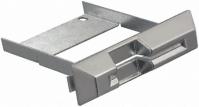
Finding a nice smartcard bezel was not easy. I found a nice metallic bezel from Amphenol, it is kinda expensive but it very nice indeed. The idea is to mount this bezel on an opaque black plexiglass piece and then mount this piece on the PC case. But first i have to find a way to fix the PCB onto the bezel's base...
 |
 |
 |
| This is the smartcard bezel from Amphenol |
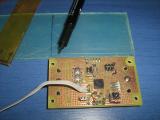
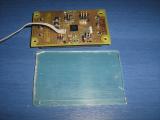
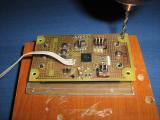
To mount the PCB on the bezel base i cut this plexiglass piece |
It is somewhat longer than the PCB |
 |
 |
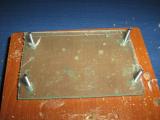 |
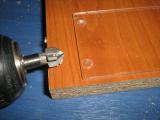
| I drilled 4 holes to screw the PCB on the plexiglass piece |
I will be using sink-screws so i had to make the countersink |
Going good... |
And this is how the pcb is mounted on the bezel's base...
Finishing the project
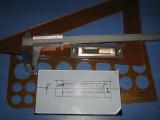
What's left?
 |
 |
 |
 |
| First i got a piece of black opaque plexiglass and marked the holes for the bezel |
i removed those holes |
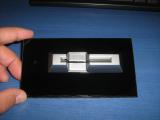
This is how the bezel will fit |
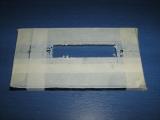
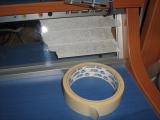
Then i put paper tape on the panel of my PC box |
 |
 |
 |
 |
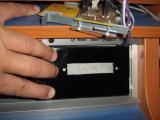
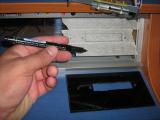
| I put the plexiglass on the panel |
and drew the required openings |
Which i removed again... |
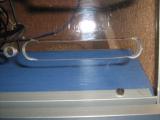
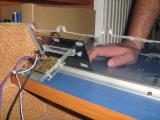
I fixed the black plexiglass on the PC panel plexiglass with double side duct tape |
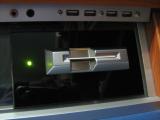
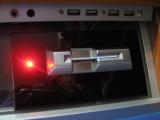
It is nice, isn't it?
 |
 |
 |
| With the correct card inserted |
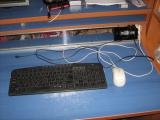
Wrong card! |
|
Comments
At 25 October 2015, 7:00:24 user Giorgos Lazaridis wrote: [reply @ Giorgos Lazaridis]@Oliver I found this one on ebay
At 22 October 2015, 15:06:45 user Oliver wrote: [reply @ Oliver]Hi,
Where can I buy a smartcard slot? (the one you solder on the PCB)
Regards,
Oliver
At 20 August 2015, 22:08:48 user Giorgos Lazaridis wrote: [reply @ Giorgos Lazaridis]@doug No i do not have them as commercial units. But I do design commercial products for customers. If you wish you can contact me by email and discuss your needs.
At 20 August 2015, 17:39:11 user doug wrote: [reply @ doug]Giorgos, That is great. Are you or anyone commercializing these at all? I would buy 50 right now for a specialized facility I have but not sure I want to build that many myself.....
At 19 August 2015, 21:25:40 user Giorgos Lazaridis wrote: [reply @ Giorgos Lazaridis]@Piyush Pandey I use the photographic transfer method.
At 11 August 2015, 12:01:12 user Piyush Pandey wrote: [reply @ Piyush Pandey]This is a very cool project of yours and I must admit that its a very well documented as well with snapshots wherever required.
But Giorgos I want to know that what is the procedure you followed in making the
PCB as I am greatly impressed the print and cleanliness of the PCB.
At 21 October 2012, 4:54:26 user PCB Assembly wrote: [reply @ PCB Assembly]This was one of the most well documented blog entries I have read in a long time. It was a pleasure to fill all the gaps I had about this topic. Well written an concise.
At 3 September 2012, 21:14:58 user pcb wrote: [reply @ pcb]Thanks for share this pcb layout design work... its give me more better ideas for my future projects...
At 3 September 2012, 21:04:29 user Thanassis Mavrogeorgiadis wrote: [reply @ Thanassis Mavrogeorgiadis]Very good project. Well done George!
At 14 August 2012, 20:56:06 user Giorgos Lazaridis wrote: [reply @ Giorgos Lazaridis]@Pat I see what you mean... I think i will make some tests :D
At 14 August 2012, 20:09:12 user Pat wrote: [reply @ Pat]@Giorgos Lazaridis Yeah, like I said, it'll work... mostly. If you take a look at TPC 12 on the ADG714 datasheet, the frequency response at ~500 MHz is going to be around -8 dB. The maximum attenuation of a USB cable is basically the same as that ( http://www.usb.org/developers/presentations/pres0410/2-2_SSUSB_DevCon_PHY_Heck.pdf ) - so essentially, you've basically just put in a long USB cable.
So long as you're talking about devices that are attached with, say, like a 1' cable or something like that, you won't notice basically anything. It's all just a question of how much margin you have left.
At 14 August 2012, 19:48:27 user Giorgos Lazaridis wrote: [reply @ Giorgos Lazaridis]@Pat this was one of my concerned, it works ok until now, and i have test usb devices like external HDD (which i copied some 300GB of data with no problem) and also my camcorder uses the USB for the video. Nevertheless, have order relays with 4p2t if the adg fails or have slow data transmission.
At 14 August 2012, 18:23:49 user playfsx wrote: [reply @ playfsx]molis eida smartcard lock skeytika oti enas apo ellinas eixe kanei kati paromio me tilekartes kai tsoup na se pali :P ! ekseretiki douleia opws panta !
At 14 August 2012, 14:39:43 user Pat wrote: [reply @ Pat]"I'm not sure if the ADG714 can be used for USB applications."
No, it can't. It's the bandwidth that matters, not the on-resistance. It has a bandwidth of 155 MHz, which is way below USB spec. This is because the ADG714's input/output capacitance isn't 6/4 pF: I'm not sure where you got that from (the digital input/output capacitance is 3/4 pF respectively). Its on capacitance is *22* pF. This is way, way too high: on a 50 ohm input that's a critical frequency of ~150 MHz.
Switches designed for USB (like the FSUSB46) have on capacitances more like 4 pF, leading to a bandwidth of well greater than 480 MHz.
This design will work... some of the time. Probably mainly with short USB cables and devices that are well within USB spec. Definitely with low-speed USB devices. But high-speed USB devices could easily struggle since you're probably tacking on at least ~6 dB of attenuation.
At 4 July 2012, 8:01:53 user George Karkalis wrote: [reply @ George Karkalis]Nice app,useful and educational if I may say so! |
|
 HOT in heaven! HOT in heaven!

|
|




 Home
Home
 Projects
 Experiments
 Circuits
 Theory
 BLOG
BLOG
 PIC Tutorials
 Time for Science

 Contact
 Forum
Forum
 RSS
RSS



 Reddit this
 NEW in heaven!